
|
An exceptionally rare clip point version of the Napoleonic French heavy cavalry trooper's sword, with clear signs it is a true Waterloo battle trophy.
A very small number of An XIII Cuirassier trooper swords exist with their original clip point intact; this is one of them. The vast majority blades were converted to spear point just before Waterloo, and afterwards all such blades that remained in service with the French army were converted. This sword, blade dated to January 1815, was one of the few that was not converted and clearly was at Waterloo.
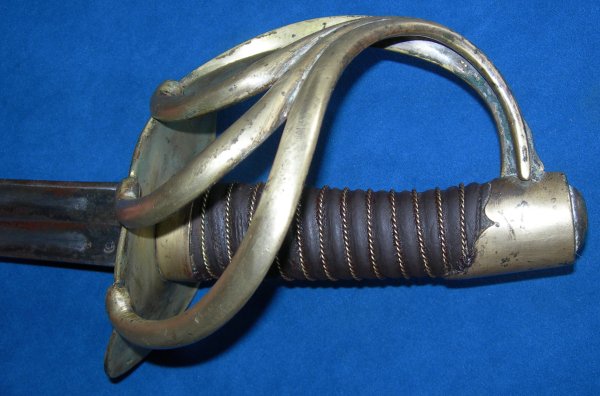
It is clear this is a Waterloo battlefield pick up because the blade is dated to January 1815, there are no post-1815 markings, the blade has not been converted to spear point, the blade has not been rehilted into the 1816 model hilt, and there is slight telltale damage. Damage that does not detract from the sword, but really enhances it. The sword has obviously taken a heavy tumble, as the thick brass hilt has compression and some joint fractures, plus the blade tip is very slightly skew. Many a cuirassier fell that day, sword in hand. And their swords proved to be the most popular battle trophy for British forces to take home. In fact, the hilt is not original to the blade, so we know a little more of the history of this sword. The hilt has two sets of rack numbers, one stamped out, plus the original "Versailles" stamp still barely visible. This hilt predates 1815 and received a new blade, clearly because the original one had been damaged. Shortly before the 100 Days War (Waterloo), the French pressed every available military item into service, and hence serviceable hilts with damaged blades received new blades. So who knows what battles this hilt had seen before, perhaps the invasion of Moscow. In any event, there is a lot of history bound in this sword, the last piece being Waterloo itself. The full sized 38 inch clip point blade is in generally very good condition. The point section is a little off, not much. The "Royale" section of the Klingenthal blade inscription is rubbed feint, presumably done by the heavy cavalry trooper who once held it (January 1815 fell within the "First Restoration" of the French monarchy, so blades made in that period were inscribed "Royale" not "Imperiale". The three round inspection marks (poinçons) are correct for the blade date. There is a slight movement of the blade within the hilt, only slight. The hilt has taken an almighty bang / fall, commensurate with a heavy calvary trooper falling from his horse with his sword in hand. There is a slight bending to the guard in places, and slight fractures to the welding od the bars to the front guard (visible only from inside the hilt). You would not see any damage at first glance, which means the damage enhances the sword, for sure, and increases it value. The leather grip is original, some wear (the underside twine bindings showing through in couple of places, a small section of loss in another), which is a huge bonus. The twisted grip wire bindings are a later replacement, though faithfully done. The steel scabbard has seen better times; the show / chape has medium to heavy rust pitting, there is a light pitting to most of the scabbard, though the chemical browning used by the French mostly remains. The scabbard is still exceptionally heavy and solid. The swords still sheathes and draws very well. Waterloo battle trophy and a clip point blade; it simply does not get better than that. The price is therefore sure to be an investment; these swords are incredibly hard to source now and the prices just keep on rising. Please quote item reference G86 (975). Further / full sized images available upon request.
|





| Copyright © Antique Swords .Com (formerly SwordSales EU / Antique-Swords EU) - All rights reserved |