French AN XIII Cuirassier Sabres Article |
I felt the need to write this article about French Napoleonic
AN XI / XIII heavy cavalry swords because of the amount of false
/ misinformation out there on the subject, especially regarding
Waterloo captured swords. Part of the problem is the proliferation
of so-called experts on the subject, each with their own views and
agendas, where those views are too often selfish (they do not want
anyone else having a special sword) and / or simple intransigence
where they have stated something as fact and will never change their
tune, no matter how much evidence is against them, simply out of
false pride.
The French An XIII heavy cavalry trooper's sword is my favorite
of all weapons, and I have handled close to a hundred of them over
the years. I have exchanged information, observations and ideas
with a number of collectors of AN XI / XIII, museums and authors.
I believe the following clears up many of the cloudy or sometimes
falsely stated areas of these highly sought after Napoleonic French
swords. It is a minefield as to whether each sword found in the
UK was a war trophy or not (think Waterloo) but, there are so many
of them that the notion these were all 60's / 70's tourist bring
backs is, quite frankly, a joke.
AN XI Vs. AN XIII
Roman numerals used by the French to indicate the years 1802 and
1804 (based on the revolutionary calendar). Regarding Cuirassier
sabres their meaning is easy. AN XI (1802) is when the famous Cuirassier
sabre used in the Peninsula War, the Russian Campaign and the 100
Days War (Waterloo) was introduced. AN XIII (1804) is when that
same sword was given an official model designation by the French.
It gets confusing because the French often today refer to the sabre
as the AN XI, while the British with their need to be official about
everything call them AN XIII’s; they are the same thing (though
the sword was improved over the years).
Some experts / authors such as Lhoste and Resek describe the AN
XI and AN XIII as different swords by pointing out the junction
of the hilt bars into the pommel (earlier sabres having only the
knucklebow join the pommel, later sabres having the knucklebow and
a union of the three hilt bars join it; this was done to strengthen
the hilt) and a difference in blade and / or scabbard design. This
is an over-statement, like all swords the manufacturers improved
them as time went on. There are no separate AN XI and AN XIII models
(see books by Michel Petard), they are the same sword with improvements
being made from the originals as you would expect culminating in
the final official model in 1804.
But, if you are buying in the UK, the earlier swords are generally
referred to as An XI.
Spear Point Vs Clipped Point and Waterloo
This is in context to AN XIII sabres found outside France.
Some collectors and “experts” claim that a spear pointed
AN XIII sabre means the sword post-dates Waterloo when it was decommissioned
one way or another. This is based on a theory that the French did
not modify the original clipped points of AN XIII Cuirassier sabres
until after Waterloo; this is not true.
First, it is important to realize that all French heavy cavalry
trooper sabres of this era had clipped points when they were made
until 1855, except for special orders for spear points made according
to Michel Petard (famous French author) during the height of production;
the height of production for AN XIII’s was during the final
stages of Russian Campaign and just prior to the 100 Days War; 1814
to early 1815, before Waterloo. Most spear pointed AN XIII’s
however were not made that way, they were modified by the regiments
that used them. It is ironic how some collectors accept the British
modified their 1796 Pattern heavy cavalry sabres to spear points
prior to Waterloo in response to the superiority of the thrust (penetration)
capabilities of the spear pointed French AN XIII and yet somehow
claim the French did not have spear pointed blades when it comes
to pre-Waterloo French sabres!
You only have to look at the numbers / greater percentage of spear
pointed Vs original clipped pointed AN XIII’s that come onto
the market in the UK to realize the French had spear pointed most
of their AN XIII’s prior to waterloo. How else did all these
spear pointed AN XIII’s without post-Waterloo inspection marks
(when the fragile brass hilts or scabbards were replaced for example)
get to the UK? Are we to believe the British had an insatiable desire
to buy them from the French in 1816 and again in 1822 when the hilt
design was changed, or in 1855 when the model was replaced? How
come many spear pointed sabres can be found in Waterloo Exhibitions
at Museums (e.g. the Musee de Centre General Gerard at Ligny in
Belgium). Please! The vast majority of AN XIII’s in the UK
are war trophies; either battlefield pick-ups or confiscations after
the event. Either way, they nearly all are certain to be Waterloo
or earlier era sabres.
Telling an AN XIII battlefield pick-up
The signs for a battlefield pick-up, a sword taken from a fallen
/ injured French Cuirassier are;
a) Some form of damage from being used or having fallen.
b) The lack of / or having a mismatched scabbard; not always but
most battlefield pick-ups would be An XIII swords out of their scabbards,
as the trooper who held them would most likely have had his sword
drawn when he was injured or felled, and because he would likely
have ridden or been dragged away by his horse so as to separate
the two. A mismatched (different serial number) sword to scabbard
is a very good indication it was a fallen sword, shortly after matched
to another trooper's scabbard.
c) The number of grip wire turns; pre-Waterloo swords are unlikely
to have more than 11 or 12 turns. Swords that stayed in French military
service, if they did not have their hilts removed for the new 1816
and 1822 models, would likely have new grips along the way with
15+ grip wire turns.
d) Waterloo trophies will not have post-1815 French inspection marks
(poinçons). And this aspect is the minefield.
When trying to determine if an AN XIII lost its scabbard at Waterloo
or at a later date, check the blade condition with the leather grip
condition as these both are prone to decay by dampness. If the blade
is in very good order but the grip is very poor, if you do not have
a scabbard it is likely because the thing rusted away. If the blade
and the grip are commensurate with being exposed to the air around
them for a very long time, then it is almost certainly a Waterloo
war trophy. As I said, some battlefield pick-ups would have involved
having the original or another nearby scabbard.
Next, check the hilt and scabbard if you have one for post-Waterloo
French inspector stamps. Some, although not all of these are listed
here: Klingenthal
Inspection Marks - remember Versailles had its own stamps and
that many hilts were made in Versailles; I have a reference book
of these. Also, these swords were made by mostly Parisian sword
/ blade makers and are invariably marked to the blade "AP"
("Atelier de precision") with a licteur (note: most people
believe "AP" meant Arsenal Paris, but that is not true;
just another belief made "fact"). If nothing is post-Waterloo,
the sabre is unlikely to have been carried after the battle, heightening
the likelihood it was a war trophy carried home by a British soldier.
Red Balaran Herrings
Many experts point to B under star poinçons on some An XIII
hilts as being proof that the sword stayed in service with the French
army after the 100 Day War (Waterloo), that the B is the poinçon
of Captain Inspector Balaran (1834 to 1836). And yes, Balaran did
in fact have a chubby B under star poinçon.

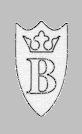
But, first, many of the swords with a B poinçon are clearly
not of chubby Balaran; they are a B under crown in a skinny shield,
such as this one;

This is clearly the B Crown poinçon of the unknown (unnamed)
inspector of the time (1814) at the private side of Klingenthal,
Coulaux;
You see, during the time of maximum French production / weapons
need just before the 100 Days War (Waterloo), private arms makers
such as Coulaux were sequestered in to help. Part of the effort
was to return older swords to service, so you will often see the
old rack numbers struck out (as above) with a new number and inspection
mark; an inspection mark (poinçon) dating the sword's reissue
to 1814 / 1815.
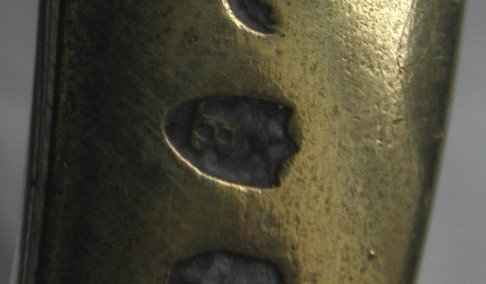
Below is an alleged B star poinçon of Balaran (1834 to 1836)
(note, it is much larger than the B crown poinçon example
above). I say "alleged" because I have seen some swords
with this poinçon with nothing else about them that speaks
of being in service post-1815. And this chubby pointy shield bottom
poinçon has a different shape to the known above illustrated
rounded bottom Balaran poinçon. I therefore very much believe,
given there are no other post-1815 features, that the chubby pointy
shield B is not a Balaran poinçon either.
In fact, I have handled one sword which has a (damaged) chubby(ish)
B under star poinçon which clearly would / could not have
been inspected and approved by Balaran, this one;

Look closely, there are original non-French poinçons above,
suc as a W poinçon. Then, a later B under star poinçon,
and newer rack numbers were punched over older ones (NB: this is
quite unusual as normally old French rack numbers were crossed out
and the new ones put to the side). The original poinçons
I believe are Dutch (it is a W not an M, and it is not Chaterllerault's
reviser Wiedman; it is the wrong shape) which tallies with the scabbard
of the sword which has Dutch troop and weapon number style markings
and another non-French poinçon to the chape / drag. The sword
in question also has a Klingenthal Blade dated April 1814, which
is almost certainly a replacement blade as it slightly ill fits
the presumed Dutch scabbard.
This Dutch French An XIII I believe saw service under the Napoleonic
French Empire when Holland was part of that empire, suffered blade
damage, was sent to Klingenthal for a new / replacement blade and,
although the blade did not sheath perfectly, was sent back into
service with a French Cuirassier under Napoleon (there was a rush
/ need to provide weapons when Napoleon came back into power after
his first exile in 1814). I can see no reason at all why Captain
Inspector Balaran would somehow inspect and approve for service
this Dutch French An XIII 20 years later; it simply does not make
sense and therefore the above B under star poinçon is not
that of Balaran and almost certainly dates to 1814/1815.
For some strange reason, perhaps a particular regiment or for ceremonial
purposes, the French did still make / maintain An XIII swords after
1815/1816 (1816 being when the new 1816M heavy cavalry sword came
into being, much like the An XIII but most notably with a forward
facing edge to the guard / hilt). So you will find An XIIIs that
date to around the time of Balaran, so his actual poinçon
actually will appear on some, but not many of these swords. And
these later An XIIIs are not as well made as the originals in my
opinion.
It is also worth remembering, that many of the original An XIII
blades were removed from their Napoleonic hilts and re-hilted into
the later 1816M and even later still 1822M (some at least had straight
blades, though the vast majority and official model spec were slightly
curved). So finding original untouched An XIIIs with post-1815 poinçons
is rare. For me, with the French purse very tight at the end of
the 100 Days War, as there are plenty of examples to prove this,
the original An XIII blades were remounted into 1816 and even 1822
model hilts as the blade were very much still well made / serviceable
and not a lot different to the new 1816M blades.
I am fairly sure that the B under star poinçon on the above
Dutch French An XIII is the chubby variety. But, just to make matters
worse / confusion greater, I have found another, skinnier B under
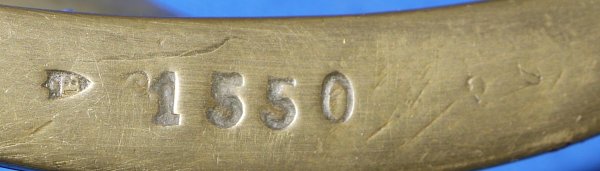
star stamp on several An XIII's (see below). The below example shows
this unknown / different, possibly a Coulaux inspection stamp against
a weapon number of 1550, where the blade was dated January 1815.
Because of this fact (the blade date), and where existing serviceable
hilts receiving new blades (because of battle damage to the blade)
entailed the old hilt getting additional newer rack numbers &
poinçons (with the old rack numbers crossed out), this hilt
is almost certainly original to the blade and thereby of approximately
the same date due to there being only one rack number.
Because the B under star poinçon below (note also: with a
speckled / egg shell type effect background) is much skinnier than
the alleged (chubby) Balaran poinçon, my judgment is that
it could not be for Balaran.
Here is what I believe is a definite Balaran poinçon (see
the stamp and letter are both chubbier, and the B is slightly at
an angle with the shield base rounded as per the illustrated Balaran
poinçon seen further above) on an An XIII which was in service
with the French army in 1834 and perhaps beyond;

And I believe this above example is the reason some collectors feel
that all B under star or crown poinçons mean post-1815. You
see, to confuse matters further, for some unknown reason, there
were a few An XIII's made / kept in service long after the sword
model was officially superceded / replaced, and the above example
is from the hilt of just such a later An XIII. I have not seen many
of these, but they do exist. Unfortunately the blade of this one
was apparently rubbed down and then electroplated, so the date inscription
and poinçons could not be seen (this may also mean that there
were no poinçons / date inscription, so the blade could also
be post-1815).
In addition, I have also seen pre-Waterloo dated rehilted An XIII
blades and even complete original swords with an alleged Balaran
poinçon, which would mean some swords stayed unmodified (the
blades were not removed and rehilted into later model hilts) and
in service for many years. Yet I can find no trace of any mention
of any French heavy cavalry troopers carrying An XIII swords in
battle after 1816, so again the alleged Balaran hilt poinçon
seems to be debatable.
Just to confuse matters more, the An XIII sword example below has
a September 1814 dated blade but with a hilt with a single rack
number (more than implying the hilt is original to the blade) and
two particular poinçons; one appears to be the same as the
Dutch French hilt's star over B poinçon, and also a C under
star which is for (Captain inspector) Colliot de la Hattais (1832).
The C Star stamps indicates the B Star stamp could not be for Balaran,
because Colliot de la Hattais was the inspector before Balaran,
and I can think of no likely reason why both Colliot de la Hattais
and Balaran would inspect and stamp the same An XIII with a single
rack number and earlier blade so close together in time, as there
is only one rack number (so no need to Colliot de la Hattais to
inspect in 1832 and then very soon after for Balaran to inspect
in 1834). The likely truth again therefore is that the mystery B
star poinçon dates to around 1815, and this sword stayed
in service with the French (without being converted to an 1816M)
and then was reinspected by Colliot de la Hattais in 1832 as was
quite likely to happen with an aging weapon.
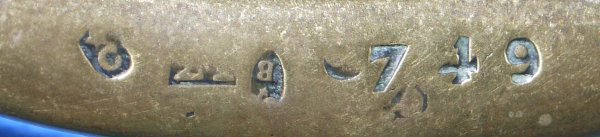
As you can see on all three of the above examples, there are other
markings that could be old, rubbed out poinçons, but I do
not believe so, as I have inspected each and there is no apparent
reduction of the original hilt. And the official French method for
giving a hilt a new rack number was to simply strike out the old.
To make things easy / simpler, I would summarize;
B under Crown skinny poinçon = definitely pre-Waterloo
B under Star skinny poinçon = 99.99% likely pre-Waterloo
B under Star medium / chubby(ish) pointy bottom poinçon =
99.99% likely pre-Waterloo
B under Star chubby rounded bottom poinçon = Balaran, 1834,
maybe! (check other facits of the sword)?
The so called 1816 scabbard (AKA Mark 3 Scabbard)
This is another aspect often used to try and deny an AN XIII having
been a Waterloo war trophy. In 1816 the French approved the Mk 3
/ 1816 scabbard for AN XIII Cuirassier sabres, so every sabre with
one of these Mk. 3’s is claimed by some to show it is a post-Waterloo
acquisition; nonsense! Just like the AN XI (1802) Vs AN XIII (1804)
sabre scenario / explanation, the MK 3 scabbards too were made ahead
of the model date, in this case before Waterloo. The French would
introduce a new piece of equipment and it would become official
at a later date; the reverse of what happened with British patterns.
Mk. 3 scabbards were made from 1814 and you can find examples of
these on sabres in Museums known to have come from Waterloo, such
as the Musee de Centre General Gerard in Belgium. We have handled
several examples where the blade spine is dated pre-Waterloo, the
hilt has only one serial number (so it can be dated to the same
date as the blade) and where the serial number on its Mk 3 scabbard
is the same; thus proving beyond all reasonable doubt Mk 3 scabbards
were made before Waterloo as well as after.
Mk. 1, Mk. 2 and Mk. 3 scabbards.
Mark 1 scabbards were too flimsy, so they were replaced. Mark 2
scabbards were too heavy (often made of iron) and were replaced.
Mark 2 scabbards had lyre shaped chapes. Mark 3 scabbards have guitar
shaped chapes. Some people claim the Mk. 3 scabbard was introduced
to accommodate the spear point blades; nonsense. Spear points for
French Cuirassier blades were not regulated (ordinarily made that
way) until 1855; spear pointed blades are mostly in service modifications
made by regiments. You can tell this is true by putting an original
unmodified clip pointed 97 cm bladed sabre into a Mk. 3 scabbard;
it fits perfectly.
The number of grip ring binding turns.
One of the useful ways of spotting fake / reproduction AN XIII’s
is the number of ring turns for the grips twisted wire bindings.
Most authentic AN XIII’s have around 11 turns. The most common
reproductions have 15 or 16. But, some authentic AN XIII’s
do have more turns, 15 or 16, though these are in the minority.
It seems the reason for an authentic AN XIII to have 15 or 16 turns
is a) that it is an early sabre with the original grip, b) that
the hilt has been re-griped according to later preference, c) that
the sabre was help by a dragoon, not a cuirassier or d) that the
sabre was issued to Dutch / Belgium Cuirassiers when those countries
were part of the French Republic.
How to spot fake AN XIII’s
This mostly relates to AN XIII sabres with blades marked to Klingenthal
1) Blades with October 1813 dates to the spine are most often fakes.
In any event, check the date on the blade’s spine with the
little round inspection marks (poinçons) on the forte / ricasso
here: Klingenthal
Inspection Marks - If they do not agree with each other, the
blade is not authentic.
2) Some reproductions do not have a lower ferrule where the grip
meets the front guard; almost every authentic AN XIII has a lower
ferrule though please note, very early production versions and those
made for Dutch / Belgium Cuirassiers may not (though the majority
do).
3) The junction of the guard with the pommel is often wrong with
reproductions; both the knucklebow and a union of the 3 hilt bars
should join the pommel, unless the sabre was made in 1802 or 1803.
4) The quality of the poinçons, in particular the wreathed
B of Bick is often poorly done on reproductions; also many reproductions
only have two not the correct three poinçons.
5) Reproductions generally have pigskin made to look like leather
grips; check the colour and quality.
6) Reproductions often have thinner ring wire binding gauges; make
sure the twisted wire is thick like it should be.
Check known reproduction wholesaler sites such as Military
Heritage AKA the Discriminating General, WorldWide
Arms and Stromlo
Swords to compare.
I have seen other earlier reproductions with "Mfure
Impale du Klingenthal" to the spine (there
should be more after, either Coulaux / Coulaux frères or
the month and year), no poinçons, and thin vinyl over this
grip twist twine (with no twisted grip wire).
Finally
Bear in mind most but not all An XIII blades were made in Klingenthal
- so some authentic blades (such as Atelier de precision blades)
will have totally different markings.
|


